
Table of Contents
Introduction

In the intricate world of construction, manufacturing and engineering, the reliability of every component is critical. Hexagonal bolts in particular are indispensable fasteners that are key to ensuring structural integrity and operational safety. However, despite their wide range of applications and seeming simplicity, improper selection, handling or installation of hexagonal bolts can lead to a range of costly errors, from minor inefficiencies to catastrophic failures.
At Haosheng, a leading manufacturer of high-strength fasteners with a monthly production capacity of more than 6,000 tons, we understand that quality hex bolts play a vital role in your project. Our commitment to international standards such as DIN, ANSI/ASME, BS and GB, as well as our ISO 9001:2008 certification and comprehensive quality control, is designed to help our customers avoid these pitfalls. This blog post will take an in-depth look at nine common and costly hex bolt mistakes and, more importantly, provide actionable strategies to avoid them, ultimately saving you time, money and potential headaches.
The Hidden Costs of Hex Bolt Mistakes
The consequences of hexagonal bolt failure go far beyond the immediate damage. Repair downtime, replacement of damaged parts, potential legal liabilities and reputational damage can quickly add up to significant costs. Understanding these potential costs highlights the importance of paying attention to every detail at every stage, from material selection to final torque application.
Error 1: Incorrect Material Selection
One of the most fundamental and frequent errors involves choosing the wrong material for your hex bolts. Different applications demand specific material properties, such as resistance to corrosion, high temperatures, or extreme tensile loads. Using a standard steel bolt in a marine environment, for instance, will lead to rapid corrosion and failure. Similarly, a low-grade bolt in a high-stress application will stretch, deform, or fracture.
How to Avoid It:
- Understand the Environment: Assess the operational environment thoroughly, including temperature fluctuations, humidity levels, exposure to chemicals, and potential for galvanic corrosion.
- Specify Grades: Always specify the required material grade, such as 8.8, 10.9, or 12.9, which denote specific strength characteristics. Haosheng specializes in these high-strength grades, ensuring you get the right material for demanding applications.
- Consult Standards: Refer to international standards (DIN, ANSI/ASME, BS, GB) for guidance on material suitability for various applications.
Error 2: Improper Size and Length
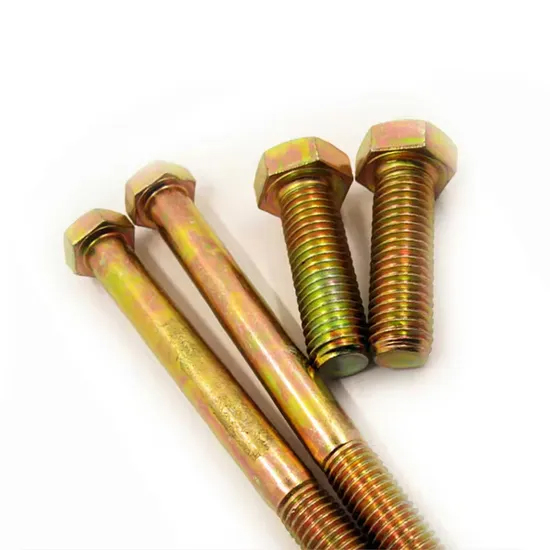
Selecting the wrong diameter or length for a hex bolt can compromise the joint’s integrity. A bolt that is too short may not provide sufficient thread engagement, leading to stripping. A bolt that is too long might bottom out before clamping the joint effectively, leaving the connection loose.
How to Avoid It:
- Measure Accurately: Precisely measure the thickness of the materials being joined and account for washers and nuts.
- Refer to Specifications: Always adhere to the design specifications provided by engineers or equipment manufacturers.
- Consider Thread Engagement: Ensure that the bolt length allows for proper thread engagement with the nut, typically at least one full thread protruding beyond the nut for optimal strength.
Error 3: Overtightening
Overtightening a hex bolt is a surprisingly common mistake with severe consequences. Excessive torque can stretch the bolt beyond its yield strength, leading to permanent deformation, reduced clamping force, and eventual fatigue failure. It can also damage the threads of the bolt or the nut, or even the material being joined.
How to Avoid It:
- Use Torque Wrenches: Always use calibrated torque wrenches to apply the specified torque.
- Follow Torque Specifications: Adhere strictly to the manufacturer’s recommended torque values. These values are determined through extensive testing and are crucial for the joint’s performance.
- Understand Fastener Lubrication: Lubrication can significantly affect the amount of torque required to achieve a specific tension. Account for this if lubricants are used.
Error 4: Undertightening
Conversely, undertightening is equally problematic. A hex bolt that isn’t sufficiently tightened will not provide the necessary clamping force, allowing the joint to loosen under vibration or dynamic loads. This can lead to component movement, fretting, wear, and ultimately, structural failure.
How to Avoid It:
- Calibrate Tools: Regularly calibrate torque wrenches and other tightening tools to ensure accuracy.
- Train Personnel: Ensure that personnel responsible for installation are properly trained in tightening procedures and the correct use of tools.
- Implement Quality Checks: Conduct random checks on tightened fasteners to verify proper torque application.
Error 5: Reusing Damaged or Worn Hex Bolts

Reusing hex bolts that are damaged, stretched, corroded, or have worn threads is a significant safety hazard. Once a bolt has been subjected to its yield strength, its material properties are permanently altered, making it unreliable for future use. Corrosion can weaken the bolt’s cross-section, and worn threads reduce clamping ability.
How to Avoid It:
- Inspect Thoroughly: Always inspect hex bolts for signs of damage, stretching, corrosion, or thread wear before reuse.
- Discard Compromised Bolts: If there’s any doubt about a bolt’s integrity, discard it and use a new one. The cost of a new bolt is negligible compared to the cost of failure.
- Follow Manufacturer Guidelines: Some applications may specifically prohibit the reuse of certain types of fasteners. Always follow these guidelines.
Error 6: Ignoring Proper Washer Usage
Washers are not just an afterthought; they play a crucial role in distributing the load evenly under the bolt head and nut, preventing damage to the mating surface, and sometimes acting as locking mechanisms. Ignoring their use or using the wrong type of washer can lead to uneven load distribution, surface damage, and fastener loosening.
How to Avoid It:
- Select Appropriate Washers: Use washers appropriate for the application, such as flat washers for load distribution, lock washers for vibration resistance, or spring washers for maintaining tension.
- Ensure Correct Orientation: Install washers correctly, especially lock washers, to ensure they provide their intended function.
- Consider Surface Finish: Use washers that complement the surface finish of the joined materials to prevent marring.
Error 7: Mixing Metric and Imperial Hex Bolts
In an increasingly globalized world, projects often involve components from different origins. A common and dangerous error is inadvertently mixing metric and imperial hex bolts and nuts. While they might appear similar, their thread pitches are different, leading to cross-threading, stripping, and a compromised connection.
How to Avoid It:
- Standardize Inventory: Implement strict inventory control to separate metric and imperial fasteners.
- Clear Labeling: Ensure all hex bolts and nuts are clearly labeled with their size and thread type.
- Visual Inspection and Gages: Always visually inspect and, if necessary, use thread gages to confirm the correct thread type before assembly.
Error 8: Inadequate Joint Preparation
The performance of a hex bolt joint is highly dependent on the preparation of the surfaces being joined. Rough surfaces, burrs, paint, or debris between the contact surfaces can prevent the joint from achieving full clamping force, leading to loosening and potential failure.
How to Avoid It:
- Clean Surfaces: Ensure all mating surfaces are clean, free of debris, rust, paint, and burrs.
- Ensure Flatness: Verify that the surfaces are flat and parallel to ensure even load distribution across the joint.
- Consider Surface Treatment: Apply appropriate surface treatments or coatings if required for corrosion protection or friction control, ensuring they do not interfere with clamping.
Error 9: Lack of Regular Inspection and Maintenance
Even after correct installation, hex bolt joints can loosen over time due to vibration, thermal expansion and contraction, or dynamic loads. A lack of regular inspection and maintenance can allow these issues to go unnoticed until a failure occurs.
How to Avoid It:
- Implement Inspection Schedule: Establish a regular inspection schedule for critical hex bolt joints.
- Retorque if Necessary: Periodically check and retorque fasteners to their specified values, especially after initial operation or significant load changes.
- Look for Warning Signs: Train personnel to recognize signs of loosening, such as rust trails, visible gaps, or audible creaking.
Hex Bolt Selection and Application Guide
To further assist in avoiding these costly errors, the following table provides a general guide for selecting and applying hex bolts based on common application types.
| Application Type | Recommended Hex Bolt Grade (Example) | Key Considerations | Avoid These Mistakes |
| General Structural | 8.8 (High-strength) | Good strength-to-weight ratio, common in building structures. | Using low-strength bolts, inadequate torque. |
| High Stress/Heavy Load | 10.9 or 12.9 (Very high-strength) | Excellent tensile strength, critical for heavy machinery, automotive. | Overtightening, reusing stretched bolts. |
| Corrosive Environments | Stainless Steel (A2/304 or A4/316) | Resistance to rust and chemical attack. | Using standard steel bolts, improper sealing. |
| High Temperature | Alloy Steel (e.g., B7) or specialized alloys | Maintains strength and integrity at elevated temperatures. | Using standard bolts that will creep or soften. |
| Vibration Prone | 8.8 or 10.9 with locking mechanisms (e.g., lock washers, prevailing torque nuts) | Resists loosening under dynamic loads. | Undertightening, ignoring locking features. |
| Precision Assembly | Metric fine pitch (e.g., M8x1.0) | Allows for finer adjustments and greater clamping force per turn. | Mixing thread types, neglecting clean threads. |
Conclusion
The integrity of any engineered system often hinges on its smallest, most critical components: fasteners like the hex bolt. By understanding and avoiding the nine costly errors outlined, you can significantly enhance project safety, reliability, and longevity, while minimizing expensive downtime and repairs. Every step is vital, from selecting the correct material and size to ensuring precise torque and implementing routine maintenance.
At Haosheng, we pride ourselves on being a professional manufacturer of high-strength fasteners. Our commitment to stringent international standards, offering 8.8, 10.9, and 12.9 grade products, along with our ISO 9001:2008 certification and comprehensive quality control, ensures stable product quality and timely delivery. Don’t let costly hex bolt errors compromise your next project. For reliable, high-quality hex bolts that meet demanding specifications, contact us today and experience the Haosheng difference.
FAQ
What are the most common reasons for hex bolt failure?
The most common reasons for hex bolt failure include incorrect material selection for the application, improper tightening (both over and undertightening), and corrosion. Each of these can lead to a loss of clamping force, material fatigue, or catastrophic breakage.
How do I determine the correct torque for a hex bolt?
The correct torque for a hex bolt is typically specified by the equipment manufacturer or the design engineer. This value is crucial and should always be applied using a calibrated torque wrench. Factors like bolt material, diameter, thread pitch, and whether lubrication is used will influence the correct torque.
Can I reuse hex bolts?
It depends on the application and the condition of the hex bolt. For critical applications or where the bolt has been subjected to significant stress (e.g., stretched beyond its yield point), reusing it is generally not recommended due to compromised integrity. Always inspect bolts thoroughly for any signs of damage or wear before considering reuse. When in doubt, it’s safer and more cost-effective to use a new hex bolt.
What is the significance of hex bolt grades like 8.8, 10.9, and 12.9?
These numbers represent the strength grades of metric hex bolts according to international standards. The first number multiplied by 100 gives the ultimate tensile strength in MPa, and the second number (as a decimal) multiplied by the first number gives the yield strength in MPa. Higher numbers indicate higher strength, meaning the bolt can withstand greater loads before deforming or breaking. Haosheng specializes in producing these high-strength grades for demanding applications.
How can I prevent hex bolts from loosening due to vibration?
To prevent hex bolts from loosening due to vibration, several methods can be employed. These include using lock washers, prevailing torque nuts (nylock nuts), chemical thread lockers, or safety wiring. Proper initial torque application is also critical, as a well-tensioned joint is less likely to loosen.
 English
  Spanish
  Arabic