
In heavy duty environments, a industrial fastener is not just a small component—it is a critical structural element that determines whether a system performs safely over time or fails under pressure. From large-scale machinery and structural assemblies to pipeline systems and high-load industrial equipment, choosing the wrong fastener can lead to loosening, corrosion, fatigue failure, or even catastrophic breakdown.
If you are sourcing industrial fasteners for demanding applications, this guide will help you make informed, engineering-level decisions. Instead of focusing only on price or availability, we will walk through the key technical factors that directly impact performance, durability, and long-term reliability.
Table of Contents
Understanding Heavy Duty Fastener Requirements

Heavy duty projects typically involve:
- High tensile and shear loads
- Continuous vibration or dynamic stress
- Exposure to corrosive environments
- Extreme temperatures or pressure conditions
Unlike general-purpose fasteners, these applications require careful selection of material, strength grade, surface treatment, and installation method.
A fastener that works well in light-duty applications may fail quickly under heavy industrial conditions. That’s why selection must always be based on engineering parameters rather than assumptions.
Types of Industrial Fasteners Used in Heavy Duty Projects
Different fasteners are designed for different load conditions and assembly requirements.
Common Types
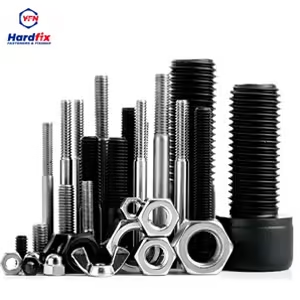
- Hex bolts: widely used for structural connections and heavy machinery
- Stud bolts: ideal for flanged joints, especially in pipeline systems
- Heavy hex bolts: designed with larger heads for higher load distribution
- Anchor bolts: used in concrete foundations
- U-bolts: used for pipe support and structural mounting
Each type provides specific advantages depending on the load direction, accessibility, and installation method.
Key Factors When Choosing Industrial Fasteners

Selecting the right fastener involves evaluating multiple technical criteria. Below are the most critical factors.
1. Load Requirements and Strength Grade
The first step is understanding the load the fastener must withstand.
Fasteners are classified by strength grades such as:
- Grade 8.8
- Grade 10.9
- Grade 12.9
Higher grades indicate higher tensile strength and yield strength.
For example:
- Grade 8.8 is suitable for general structural use
- Grade 10.9 is used in heavy machinery
- Grade 12.9 is used in high-stress, high-load applications
Choosing a grade that is too low may result in deformation or failure. Choosing one too high without proper installation may lead to brittleness issues.
2. Material Selection
Material determines both strength and environmental resistance.
Common Materials
- Carbon steel: cost-effective, high strength, but prone to corrosion
- Alloy steel: enhanced strength and toughness
- Stainless steel: excellent corrosion resistance but lower strength compared to alloy steel
- Duplex stainless steel: combines strength and corrosion resistance for extreme environments
For heavy duty projects, alloy steel fasteners are often preferred due to their balance of strength and durability.
3. Corrosion Resistance and Surface Treatment
Corrosion is one of the leading causes of fastener failure in industrial applications.
Common surface treatments include:
- Hot-dip galvanizing
- Zinc plating
- Dacromet coating
- PTFE coating
For outdoor or chemical environments, hot-dip galvanized or coated fasteners significantly extend service life.
4. Thread Type and Fit
Thread design affects load distribution and resistance to loosening.
- Coarse threads: better for quick assembly and soft materials
- Fine threads: provide higher tensile strength and better vibration resistance
Precision in thread fit is also critical. Poorly matched threads can lead to uneven stress distribution and premature failure.
5. Environmental Conditions
Consider the actual working environment:
- High humidity or marine exposure
- Chemical exposure (acids, alkalis)
- High temperature conditions
- Cyclic loading or vibration
For example:
- Stainless steel is ideal for corrosion-prone environments
- Alloy steel with special coatings is suitable for high-load mechanical systems
6. Installation and Torque Requirements
Even the best industrial fastener will fail if installed incorrectly.
Proper torque ensures:
- Correct preload
- Even load distribution
- Resistance to loosening
Using calibrated torque tools and following engineering torque specifications is essential for heavy duty applications.
Comparison Table: Industrial Fastener Selection for Heavy Duty Applications
| Factor | Option | Advantages | Limitations | Recommended Use |
|---|---|---|---|---|
| Material | Carbon Steel | High strength, low cost | Corrosion risk | Indoor structural use |
| Material | Alloy Steel | Very high strength | Needs coating | Heavy machinery |
| Material | Stainless Steel | Corrosion resistant | Lower strength | Marine, chemical |
| Coating | Galvanized | Strong corrosion protection | Thicker layer | Outdoor use |
| Coating | Zinc Plated | Smooth finish | Limited durability | Indoor applications |
| Thread | Coarse | Easy installation | Lower strength | General use |
| Thread | Fine | Higher strength | Harder assembly | High-load systems |
Application Scenarios
1. Construction and Structural Engineering
Heavy hex bolts and anchor bolts are commonly used for steel structures and foundation systems. Load-bearing capacity and compliance with standards are critical.
2. Pipeline and Flange Systems
Stud bolts are widely used in pipeline systems to secure flanges under pressure. Proper material selection and corrosion resistance are essential for long-term sealing performance.
3. Heavy Machinery and Equipment
High-strength alloy steel bolts (such as Grade 10.9 or 12.9) are used to handle vibration, dynamic loads, and repeated stress cycles.
4. Energy and Industrial Facilities
Fasteners used in power plants or processing facilities must withstand temperature variations, pressure, and chemical exposure.
Common Problems and How to Avoid Them
Problem 1: Bolt Loosening
Cause: vibration, insufficient preload
Solution: use locking mechanisms, proper torque control
Problem 2: Corrosion Failure
Cause: incorrect material or coating
Solution: select corrosion-resistant materials or protective coatings
Problem 3: Fatigue Failure
Cause: cyclic loading
Solution: use high-grade fasteners and proper preload
Problem 4: Over-tightening
Cause: incorrect torque application
Solution: follow torque specifications and use calibrated tools
Expert Insights from Manufacturing Perspective
From a manufacturer’s point of view, the most common issue is not product quality but incorrect selection and application.
In real-world projects, we often see:
- Fasteners chosen based only on price
- Mismatch between material and environment
- Lack of understanding of load conditions
A reliable supplier should not only provide products but also offer technical support, including:
- Material recommendations
- Strength calculations
- Custom manufacturing solutions
For heavy duty projects, customization is often required to meet specific structural or environmental demands.
Conclusion
Choosing the right industrial fasteners for heavy duty projects is a technical process that requires a clear understanding of load conditions, material properties, environmental factors, and installation methods.
A well-selected fastener ensures long-term reliability, reduces maintenance costs, and enhances overall system safety. On the other hand, poor selection can lead to frequent failures and costly downtime.
FAQ
What is the best material for heavy duty industrial fasteners?
Alloy steel is generally the best choice due to its high strength, but stainless steel is preferred in corrosive environments.
How do I know which bolt grade to use?
It depends on load requirements. Higher loads require higher grades such as 10.9 or 12.9.
Are stainless steel fasteners strong enough for heavy duty use?
They offer good corrosion resistance but are typically not as strong as alloy steel fasteners.
What causes industrial fastener failure in heavy applications?
Common causes include overloading, corrosion, improper installation, and fatigue.
Can I customize industrial fasteners?
Yes, many manufacturers provide custom sizes, materials, and coatings to meet specific project needs.
Need Help Choosing the Right Industrial Fasteners?
If you’re unsure about which industrial fasteners are best for your heavy duty project, our engineering team is here to help. We provide expert guidance, custom solutions, and high-quality manufacturing tailored to your requirements. Contact us today to discuss your application and get a reliable fastening solution designed for performance and durability.
 English
  Spanish
  Arabic