
Welcome to My Blog!
Before we dive into the content, if you’re interested in our products or have any questions, please feel free to visit our Contact Us page on the website. Our team is ready to assist you with inquiries, orders, or any support you may need.
Now, let’s get started on our journey together. I hope you find the content here insightful, engaging, and valuable.
Table of Contents
Introduction

Selecting the appropriate fastener assembly is critical for securing bolts and preventing vibration-induced loosening. External tooth lock washers are essential components in numerous industrial and engineering projects. These washers are specially designed to bite into surfaces and provide a firm grip, preventing nuts and bolts from loosening under pressure.
Whether you work in automotive machinery, construction projects, or electrical systems, understanding the materials, applications, and installation techniques of serrated lock washers ensures their long-term reliability and safety.
What Is an External Tooth Lock Washer?
An external tooth lock washer is a type of washer with serrated teeth around its outer edge. These teeth dig into the surface of the fastened material and the nut or bolt head, creating resistance against loosening caused by vibration or torque. Compared to standard washers, external tooth lock washers provide superior holding power in high-stress environments.
Materials for External Tooth Lock Washers

Selecting the right material for your lock washer is critical to ensure durability, corrosion resistance, and optimal performance under specific working conditions. Different materials offer unique advantages depending on the environment and application.
Carbon Steel
Carbon steel is the most commonly used material for external tooth lock washers. It provides excellent strength and rigidity, making it ideal for general-purpose applications where high holding power is required. These washers are cost-effective and suitable for machinery, construction, and automotive projects. However, carbon steel requires a protective coating, such as zinc plating, to prevent rust in humid or outdoor environments.
Stainless Steel
Stainless steel washers are highly resistant to corrosion and oxidation, making them ideal for environments exposed to moisture, chemicals, or extreme weather. They are commonly used in marine, food processing, and chemical industries. Stainless steel provides excellent long-term reliability and maintains its mechanical properties over time, even under high-stress conditions.
Zinc-Plated Steel
Zinc-plated steel washers combine the strength of carbon steel with added corrosion resistance. The zinc coating creates a protective barrier against rust, which is suitable for indoor or semi-exposed environments. Zinc-plated washers are ideal when moderate corrosion protection is needed without significantly increasing cost.
Brass and Bronze
Brass and bronze external tooth lock washers are chosen for specialized applications requiring non-magnetic and conductive properties. These materials are often used in electrical systems, electronics, or decorative assemblies. They offer moderate corrosion resistance and are particularly useful where metal-to-metal contact should not cause sparks or galvanic reactions.
Plastic and Nylon
Plastic and nylon washers are lightweight, non-conductive, and resistant to many chemicals. These washers are ideal for electronics, insulation applications, or situations where metal washers may cause electrical short circuits. While they offer lower mechanical strength than metal washers, they are highly effective in low-load fastening scenarios and provide excellent vibration resistance in lightweight assemblies.
Key Applications of External Tooth Lock Washers
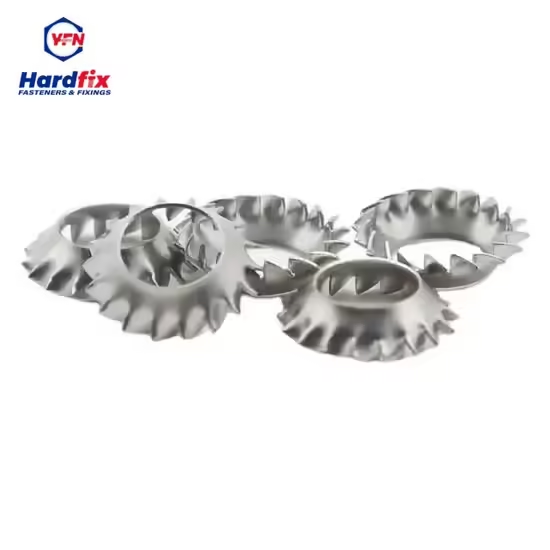
External tooth lock washers are versatile and widely used across industries:
- Automotive Industry: Prevents bolts from loosening in engines and high-vibration components.
- Construction: Ensures structural components remain secure under stress.
- Electrical Systems: Maintains grounding integrity and prevents loosening of terminal connections.
- Marine and Heavy-Duty Machinery: Provides corrosion resistance and secure fastening in harsh environments.
- HVAC Systems: Reduces maintenance issues caused by vibration and torque.
Comparing External Tooth Lock Washers
| Feature | External Tooth Lock Washer | Standard Flat Washer | Internal Tooth Washer |
|---|---|---|---|
| Anti-Loosening | Excellent | Poor | Moderate |
| Surface Contact | Outer teeth grip surface | Flat | Inner teeth grip bolt |
| Best For | Vibration-prone applications | General use | Limited torque applications |
| Material Options | Steel, stainless, brass, nylon | Steel, stainless | Steel, stainless |
This table provides a clear comparison to help you select the right type for your project needs.
Installation Tips for External Tooth Lock Washers

To maximize performance, consider these installation best practices:
- Ensure the surface is clean and free of debris.
- Position the washer so the teeth face the nut or bolt head.
- Avoid over-tightening, which may damage the teeth and reduce holding power.
- Use compatible materials for both washer and bolt to prevent galvanic corrosion.
Following these steps ensures your lock washer performs reliably over time.
Conclusion
Selecting the right external tooth lock washers is critical for maintaining secure and reliable fastening in industrial, automotive, electrical, and marine applications. Understanding material properties, applications, and installation techniques can prevent loosening, enhance safety, and extend component lifespan.
If you want to ensure your project achieves optimal performance, explore high-quality external tooth lock washers that meet your material and application requirements. Don’t compromise on reliability—start integrating the right washers today to create safer, stronger fastening solutions.
FAQ
Can external tooth lock washers be reused?
While technically possible, reuse is not recommended, as the teeth may have deformed, reducing their holding power.
Are they external tooth cations?
Yes, as long as the material is rated for the operating temperature. Stainless steel or specialized alloys are preferred for heat resistance.
How do I choose between external and internal tooth lock washers?
External tooth washers provide better grip on flat surfaces, while internal tooth washers are suitable when you want minimal surface contact or need to avoid scratching.
When should a washer be used in fastening?
A washer should be used whenever you need to improve load distribution, protect surfaces, or prevent loosening in a fastening assembly. In applications where bolts or nuts are tightened against softer materials—such as aluminum or plastic—washers help prevent surface damage and deformation. For high-vibration environments, using a washer, such as an external tooth lock washer, adds extra grip and resistance against loosening. In short, washers are essential when durability, stability, and long-term joint integrity are priorities in your fastening design.
 English
  Spanish
  Arabic