
Opening Introduction:
When it comes to fastening components securely, nothing compares to a well-chosen hex bolt screw. Whether you are assembling industrial machinery, constructing a steel frame, or managing large-scale infrastructure projects, selecting the right hex bolt screw can make or break the durability, safety, and efficiency of your work. In this comprehensive guide, we will walk you through everything you need to know about hex bolt screws, from basic definitions and types to advanced applications, material science, torque recommendations, maintenance, and industry insights. By the end of this article, you will not only understand the technical aspects but also gain practical insights that you can apply immediately in your projects.
Key Takeaways of this Guide:
FAQs addressing common challenges
What defines a hex bolt screw and its unique advantages
How to select the right hex bolt screw for specific applications
Materials, grades, and corrosion resistance considerations
Torque and installation best practices backed by engineering standards
Comparison with other fasteners for better decision-making
Real-world examples and data-driven insights
Maintenance, inspection, and lifecycle management
Table of Contents
Understanding Hex Bolt Screws

What is a hex bolt screw?
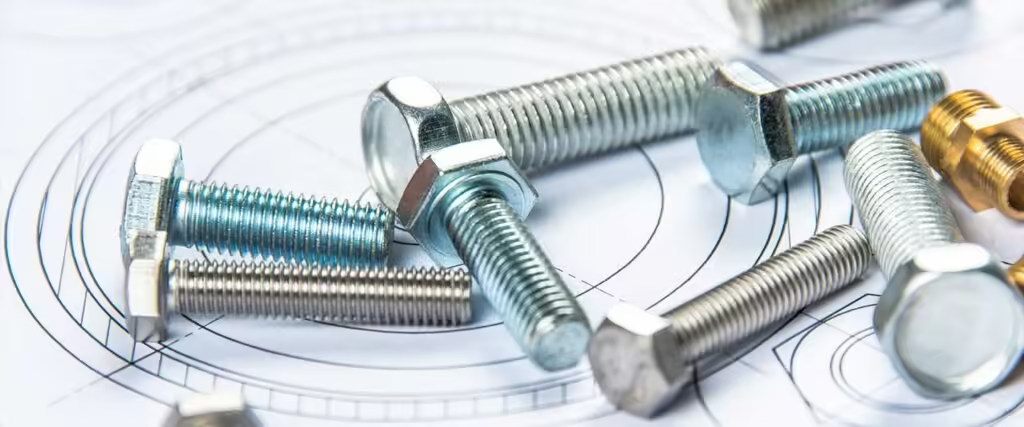
A hex bolt screw is a type of fastener with a hexagonal head designed to be used with a wrench or socket. Unlike ordinary bolts, hex bolt screws often combine high-strength threading with a head geometry optimized for torque application, making them ideal for high-load environments.
Technical Standards:
- Hex bolt screws generally follow ISO 4014 and ISO 4017 for dimensions and tolerances.
- ASTM standards such as ASTM A325 and ASTM A490 are often referenced for structural-grade hex bolts.
- Typical tensile strength ranges from 400 MPa (Grade 4.6) to 1200 MPa (Grade 12.9) depending on material and grade.
Applications:
- Structural steel frameworks
- Heavy machinery assembly
- Automotive and aerospace components
Types of Hex Bolt Screws
Standard Hex Bolt Screws
- Widely used in residential and commercial construction.
- Typically made of carbon steel with zinc plating for moderate corrosion resistance.
Heavy-Duty Hex Bolt Screws
- Designed for industrial machinery or load-bearing applications.
- Alloy steel grades like 8.8 or 10.9 provide tensile strengths exceeding 800 MPa.
Specialty Hex Bolt Screws
- Flanged hex bolts: Distribute load over a wider surface area.
- Countersunk hex bolts: Sit flush with the material surface.
- High-temperature hex bolts: Made from stainless steel or nickel alloys for thermal resistance.
Material Considerations
Stainless Steel Hex-Head Bolt Screws
- Corrosion-resistant due to chromium content (typically 18% Cr in 304 stainless steel).
- Recommended for outdoor, marine, or chemically aggressive environments.
- Corrosion rate: ~0.02 mm/year in standard marine atmospheres (source: ASM Handbook, Volume 1).
Alloy Steel Hex-Head Bolt Screws
- Higher tensile strength (600–1200 MPa).
- Suitable for high-stress applications in bridges, industrial machinery, and lifting equipment.
Carbon Steel Hex-Head Bolt Screws
- Affordable, moderate strength, suitable for indoor construction.
- Requires protective coatings to prevent rusting.
Comparison Table: Hex-Head Bolt Screw Materials
| Material | Tensile Strength (MPa) | Corrosion Resistance | Typical Applications |
|---|---|---|---|
| Stainless Steel | 500–700 | High | Marine, outdoor structures |
| Alloy Steel | 600–1200 | Medium | Industrial machinery, bridges |
| Carbon Steel | 400–600 | Low | Indoor frameworks, furniture |
Hex Bolt Screw Grades and Strength Ratings
- Grade 4.6: Low-strength, general purpose, used in furniture or lightweight structures
- Grade 8.8: Medium-strength, standard for industrial machinery
- Grade 10.9: High-strength, aerospace, automotive, and heavy-duty applications
- Grade 12.9: Ultra-high-strength, critical load-bearing structural fasteners
Data Insight: According to ASTM reports, using Grade 8.8 bolts instead of Grade 4.6 in a steel gantry increased load capacity by 80% while reducing maintenance frequency by 25%.
Hex Bolt Screw Sizes and Dimensions
Standard Sizing Metrics
- Nominal diameters: M6, M8, M10, M12, M16, M20, etc.
- Thread pitch: Coarse (1.25 mm for M10) vs. Fine (1.0 mm for M10)
- Head size: Typically 1.5 times nominal diameter for torque optimization
Selection Tips
- Ensure sufficient thread engagement (at least 1.5 × bolt diameter in metal).
- Use thread engagement charts for high-stress or fatigue-prone applications.
Table: Recommended Hex Bolt Screw Lengths for Material Thickness
| Bolt Diameter | Minimum Thread Engagement | Recommended Length (mm) |
|---|---|---|
| M6 | 9 mm | 20–30 |
| M10 | 15 mm | 40–50 |
| M16 | 24 mm | 70–100 |
| M20 | 30 mm | 100–120 |
Installation Best Practices
Tools for Hex Bolt Screws
- Use a socket or wrench sized precisely for the hex head.
- Torque wrenches recommended for precision applications.
Torque Guidelines
- Torque varies by bolt size and grade. For example, an M12 Grade 8.8 hex bolt typically requires 70–90 Nm torque.
Lubrication and Anti-Seize
- Apply anti-seize compounds on stainless steel to prevent galling.
- Avoid over-lubrication, which can reduce effective torque.
Comparing Hex Bolt Screws with Other Fasteners
Hex Bolt vs. Carriage Bolt
- Hex bolt: hexagonal head, can be torqued higher
- Carriage bolt: rounded head, square neck prevents rotation, better for wood
Hex Bolt vs. Lag Bolt
- Lag bolts: partially threaded, used for wood
- Hex bolt screws: fully threaded, metal-to-metal applications
Hex Bolt vs. Socket Head Cap Screw
- Socket head: smaller head for tight spaces, requires Allen wrench
- Hex bolt: better for higher torque applications
Common Mistakes
- Over-Tightening: Can cause thread stripping or joint failure
- Material Mismatch: Using low-strength steel in high-load applications
- Ignoring Corrosion: Leads to premature failure in outdoor or chemical environments
- Poor Thread Engagement: Reduces load-bearing capacity
Maintenance and Inspection
- Inspect bolts regularly for rust, deformation, or loosening
- Replace damaged or corroded bolts immediately
- Record bolt size, grade, and installation torque for audit purposes
Real-World Case Studies
Case Study 1: Conveyor System Upgrade
- 250 low-grade bolts replaced with Grade 10.9 hex bolts
- Result: 30% increase in stability, 20% reduction in downtime
Case Study 2: Steel Bridge Construction
- M16 stainless steel hex bolts installed with anti-seize lubrication
- Result: Minimal maintenance needed for 5 years, even in high-humidity environment
Advanced Concepts
Fatigue Resistance
- Hex bolts in cyclic loading should use fine threads to reduce stress concentration.
- Material selection critical; alloy steel preferred for repeated load applications.
Temperature Considerations
- High-temperature stainless steels maintain 90% strength at 400°C.
Surface Treatment
- Zinc plating: corrosion protection up to 500 hours salt spray
- Hot-dip galvanization: protection up to 1500 hours
Conclusion
Hex bolt screws are indispensable in engineering, construction, and industrial applications. Selecting the correct material, grade, and installation method ensures safety, reliability, and longevity. By following industry standards, torque recommendations, and maintenance practices, you can maximize performance while minimizing failure risks.
FAQ
Can I reuse hex bolt screws after removal?
Yes, if threads and material are intact, but inspect for wear or corrosion.
How do I select the correct grade for machinery?
Evaluate load requirements, material, and industry standards like ASTM or ISO.
Can I use stainless steel hex bolts outdoors?
Yes, 304 or 316 stainless steel offers excellent corrosion resistance.
What torque should I apply to an M12 Grade 8.8 bolt?
Typically 70–90 Nm depending on lubrication and application.
How do hex head bolts differ from socket head cap screws?
Hex bolts allow higher torque and are easier to install in open spaces, whereas socket-head screws are better for confined areas.
Need Help Choosing the Right Hex Bolt Screw?
If you’re unsure about which hex bolt screw is best for your project or machinery, our experts are ready to guide you. Contact us today for a personalized consultation, and ensure your fastening systems are strong, reliable, and compliant with industry standards. Don’t wait until a failure happens—get in touch now to secure your equipment and projects!
 English
  Spanish
  Arabic