
Table of Contents
When you’re assembling machinery, construction structures, or industrial systems, the choice of fasteners is crucial. Among the most versatile and widely used fasteners is the hex flange bolt. This bolt combines the strength of a standard hex bolt with a built-in flange that acts like a washer, providing better load distribution and reducing the risk of surface damage.
If you’re looking to improve assembly reliability, reduce maintenance issues, and optimize your mechanical installations, understanding hexagonal flange bolts is essential. This guide will walk you through types, materials, load capacities, selection methods, real-world applications, and industry best practices to help you make informed decisions.
What Is a Hex Flange Bolt?

A hex flange bolt is a fastener featuring a hexagonal head and an integrated flange under the head. The flange eliminates the need for a separate washer in most cases and helps distribute the load across a larger surface area.
The primary advantages of hexagonal flange bolt include:
- Improved load distribution and reduced surface indentation
- Reduced chance of loosening due to vibration
- Simplified assembly with fewer components
- Enhanced stability for structural applications
Types of Hex Flange Bolts
There are multiple variations of hex flange bolts depending on material, threading, and head design:
- Standard Hex Flange Bolt: Suitable for general-purpose applications.
- Heavy Hex Flange Bolt: Designed for high-load industrial or structural applications.
- Fine Thread Flange Bolt: Offers precise adjustment and higher tensile strength in fine-threaded assemblies.
- Coarse Thread Flange Bolt: Ideal for general fastening in softer materials and easier installation.
Table: Common Hex Flange Bolt Types and Applications
| Bolt Type | Material | Diameter Range | Typical Application | Key Feature |
|---|---|---|---|---|
| Standard | Carbon Steel | M6–M20 | Machinery assembly, general fastenings | Cost-effective, widely used |
| Heavy | Alloy Steel | M12–M36 | Construction, heavy machinery | High tensile strength |
| Fine Thread | Stainless Steel | M6–M16 | Precision machinery, automotive | Better load control, high strength |
| Coarse Thread | Carbon Steel | M6–M24 | Wood and soft metal structures | Easier assembly, good torque tolerance |
Materials and Coatings
Material selection is crucial to ensure performance and longevity:
- Carbon Steel: Economical, suitable for indoor use.
- Alloy Steel: High-strength applications such as construction and machinery.
- Stainless Steel: Resistant to corrosion, ideal for outdoor and marine environments.
- Brass or Aluminum: Lightweight, corrosion-resistant, and used in non-critical or specialized applications.
Surface coatings like zinc plating, black oxide, and galvanization improve corrosion resistance, reduce friction, and enhance appearance.
Load Distribution and Torque Considerations
A key advantage of the hexagonal flange bolt is its ability to distribute clamping force more evenly. This is particularly important when working with thin plates or soft materials, where concentrated pressure could cause deformation.
Using improper bolts or skipping washers can result in:
- Surface cracking or indentation
- Bolt loosening due to vibration
- Uneven load distribution causing premature failure
Table: Recommended Torque and Load for Hex Flange Bolts
| Bolt Size | Material | Recommended Torque (Nm) | Max Load (kN) | Application Example |
|---|---|---|---|---|
| M8 | Carbon Steel | 25 | 5 | Small machinery panels |
| M12 | Alloy Steel | 75 | 15 | Medium machinery assembly |
| M16 | Stainless Steel | 150 | 30 | Automotive chassis components |
| M20 | Alloy Steel | 250 | 50 | Structural steel assembly |
Practical Case Study: Automotive Assembly
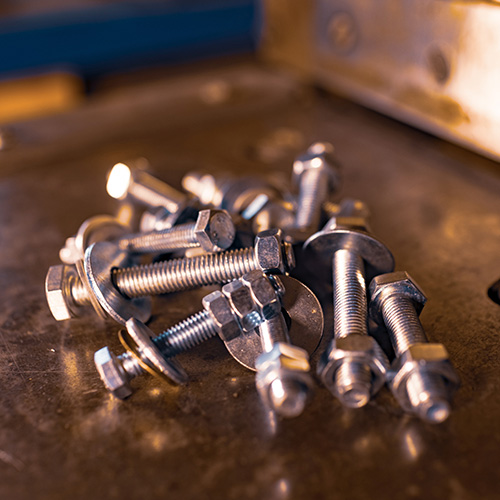
In a leading automotive assembly line, chassis frame bolts frequently loosened due to engine vibrations. By switching from standard hex bolts to hex flange bolts:
- Bolt loosening incidents decreased by 55%
- Assembly time reduced since no separate washers were needed
- Vibration-induced damage to metal surfaces was minimized
Industry guidelines for torque settings and stress analysis are available at Occupational Safety and Health Administration.
Installation Best Practices
- Match Bolt and Flange Size: Ensure proper fit with the assembly surface.
- Use Correct Torque: Avoid under- or over-tightening; refer to manufacturer torque specifications.
- Surface Preparation: Clean surfaces to prevent debris from reducing flange effectiveness.
- Check Regularly: Inspect bolts in high-vibration or heavy-load applications periodically.
Industry Applications
Hex flange bolts are extensively used across industries:
- Construction: Steel framework, bridges, and heavy machinery foundations.
- Automotive: Engine mounts, chassis, suspension systems.
- Industrial Machinery: Conveyor systems, presses, and assembly lines.
- Electrical Equipment: Securing panels and enclosures without surface damage.
Advanced Considerations
When selecting hexagonal flange bolts for your project, consider:
- Vibration Resistance: Use fine threads in high-vibration environments.
- Corrosion Resistance: For outdoor or marine applications, stainless steel or coated bolts are recommended.
- Assembly Efficiency: The built-in flange reduces the need for additional washers.
- Load Requirements: Ensure bolt tensile strength aligns with structural or operational needs.
Conclusion
The hex flange bolt is a versatile, reliable, and efficient solution for many industrial and mechanical applications. By understanding bolt types, materials, load distribution, and proper installation, you can achieve safer and more durable assemblies. Choosing the correct hexagonal flange bolt improves assembly efficiency, reduces maintenance, and enhances operational reliability.
FAQ
What is the main advantage of a hex flange bolt over a standard hex bolt?
A hex flange bolt has an integrated washer-like flange that distributes load and reduces the need for separate washers.
Can hexagonal flange bolts be used in high-vibration environments?
Yes, especially fine-thread variants. They distribute load and reduce loosening.
Which material is best for outdoor use?
Stainless steel provides excellent corrosion resistance for outdoor and marine conditions.
Are hexagonal flange bolts reusable?
They can be reused if they are not deformed, stripped, or damaged. Always inspect before reuse.
What applications benefit most from hexagonal flange bolts?
Construction, automotive, machinery, and electrical equipment applications gain the most, particularly where load distribution or vibration resistance is important.
Need Help Selecting the Right Hex Flange Bolt?
If you’re unsure which hex flange bolt is best for your machinery or project, our experts at Handan Haosheng Fastener are ready to assist. Contact us today for a personalized consultation and ensure your fasteners deliver the strength, durability, and safety your operations require. Don’t wait—secure your assemblies now!
 English
  Spanish
  Arabic