
Table of Contents
Introduction

In the realm of industrial fastening, selecting the right fasteners is crucial for a project’s efficiency, stability, and overall success. Wing nuts are designed for quick and secure tightening without additional tools, offering unmatched convenience compared to other fasteners. When paired with bolts, this combination provides enhanced versatility, particularly in applications requiring repeated assembly and disassembly. Among the vast array of fasteners, wing nuts with bolts stand out for their unique combination of ease of use and secure fastening, making them an indispensable component for industrial and engineering projects.
In this blog, we will explore the advantages of wing nuts with bolts, how to use them effectively, and their impact on project efficiency and stability.
Why Choose Wing Nut with Bolt Combinations?
Versatility in Applications
Wing nuts with bolts are incredibly versatile, making them suitable for a wide range of applications. From construction to automotive, these fasteners are commonly used in industries that require frequent assembly and disassembly. Their ease of use ensures that workers can quickly tighten or loosen fasteners without needing special tools, speeding up work processes.
Quick and Easy Assembly
One of the primary advantages of wing nuts with bolts is their ability to provide a quick and easy solution for assembling or disassembling parts. This makes them particularly useful in applications where fast adjustments are necessary. Whether you’re working on a mechanical project or setting up temporary structures, wing nuts with bolts simplify the process by allowing for tool-free assembly and disassembly.
Enhanced Stability and Security
Another key benefit of using wing nuts with bolts is the added stability they bring to your project. Unlike traditional fasteners, the wing nut design allows for a more secure grip, preventing the fastener from loosening over time. This is especially critical in high-vibration environments, where the risk of loose connections can cause serious problems.
Common Applications of Wing Nut with Bolt

Industrial Machinery and Heavy Equipment
Wing nuts with bolts are often used in industrial machinery and heavy equipment, where ease of adjustment and secure fastening are paramount. For example, in construction machinery, wing nuts help hold components in place while also allowing for quick maintenance or part replacement. This ease of adjustment helps reduce downtime and ensures that machinery remains functional.
The Benefits of Using Wing Nut with Bolt for Stability
Preventing Vibration-Related Issues
One of the most significant advantages of using wing nuts with bolts is their ability to prevent vibration-related issues. In high-vibration environments like machinery and automotive applications, wing nuts provide an extra level of security by preventing fasteners from loosening over time. This is crucial in maintaining the stability and safety of the structure or equipment.
Suitable for High-Pressure Applications
Another advantage is their strength and durability. Wing nuts with bolts are often used in high-pressure applications where other fasteners may fail under stress. They provide strong and reliable support in heavy-duty scenarios, such as in the construction of scaffolding, large metal frames, or other high-load applications.
Material Options for Wing Nut with Bolt
Choosing the Right Material for Your Project
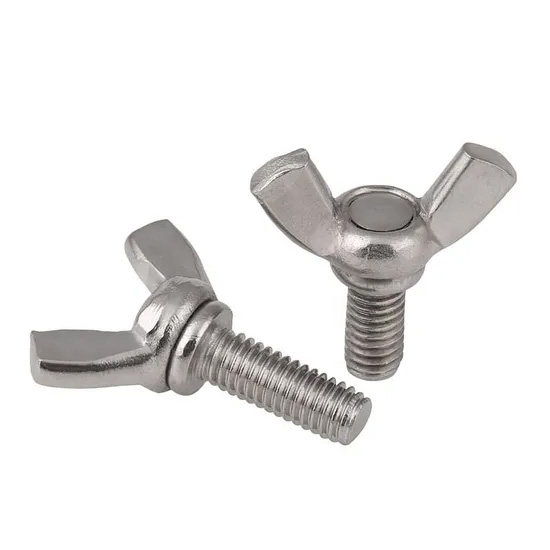
The performance of wing nuts with bolts can vary significantly depending on the material used. Common materials for these fasteners include stainless steel, carbon steel, and alloy steel. Stainless steel wing nuts and bolts offer corrosion resistance, making them ideal for outdoor or marine applications. Carbon steel provides additional strength for heavy-duty uses, while alloy steel offers a balance between strength and flexibility.
How Material Affects Performance
The choice of material can also impact the longevity and reliability of the fastener. For example, stainless steel wing nuts with bolts are less likely to rust, making them ideal for environments exposed to moisture or chemicals. On the other hand, carbon steel wing nuts with bolts may offer greater strength but might be more prone to corrosion if not treated properly.
Comparison Table: Wing Nut with Bolt Material Options
| Material | Strength | Corrosion Resistance | Ideal Applications | Durability |
|---|---|---|---|---|
| Stainless Steel | High | Excellent | Outdoor, Marine, Food Industry | Long-lasting |
| Carbon Steel | Very High | Moderate | Heavy-duty machinery, Structural | High |
| Alloy Steel | High | Good | Aerospace, Automotive | Moderate |
Conclusion
Overall, wing nut and bolt offer numerous advantages, including quick and easy assembly, enhanced stability, and superior shock resistance. Whether you’re working on heavy machinery or industrial applications, these fasteners deliver the reliability and convenience needed to get the job done efficiently.
If you’re searching for wing nuts and bolts for your next project, Haosheng offers a wide range of high-quality fasteners to meet your needs. Contact us today to explore our product lineup and find the perfect fasteners for your project.
FAQ
What makes a wing nut with bolt better than regular nuts and bolts?
Wing nuts with bolts offer the unique advantage of being tool-free, allowing for quick and easy tightening or loosening by hand. This is ideal for applications that require frequent adjustments or need to be done without the use of wrenches or other tools.
Can wing nuts with bolts be used in high-stress or high-vibration environments?
Yes, wing nuts with bolts are commonly used in high-stress and high-vibration applications. Their secure grip and design help prevent loosening, making them an ideal choice for machinery, automotive parts, and other high-load or vibration-prone settings.
How do I choose the right size of wing nuts and bolts for my project?
The size of the wing nut and bolt should match the load requirements of your project. It’s essential to consider both the diameter and length of the bolt, as well as the material and finish of the nut, to ensure it can handle the necessary pressure and provide secure fastening.
 English
  Spanish
  Arabic