
When selecting bolts for industrial use, choosing the correct strength grade is one of the most critical decisions you can make. Bolt grades such as 8.8, 10.9, and 12.9 are widely used in mechanical engineering, construction, and heavy-duty applications, but many buyers and engineers still misunderstand what these numbers actually represent—and how to choose between them.
In this guide, we break down the technical differences, real-world applications, and selection strategies for bolt grades 8.8 vs 10.9 vs 12.9, helping you make reliable and cost-effective decisions for your projects.
Table of Contents
What Do Bolt Grades 8.8, 10.9, and 12.9 Mean?

Bolt grades defined under ISO standards indicate the mechanical properties of fasteners, particularly tensile strength and yield strength.
- The first number represents the tensile strength (multiplied by 100 = MPa)
- The second number represents the ratio of yield strength to tensile strength
Example:
- Grade 8.8 → 800 MPa tensile strength, 640 MPa yield strength
- Grade 10.9 → 1000 MPa tensile strength, 900 MPa yield strength
- Grade 12.9 → 1200 MPa tensile strength, 1080 MPa yield strength
Higher numbers mean stronger bolts, but also increased sensitivity to stress conditions and installation accuracy.
Mechanical Properties Comparison
Below is a clear comparison of the three grades:
| Property | Grade 8.8 | Grade 10.9 | Grade 12.9 |
|---|---|---|---|
| Tensile Strength (MPa) | 800 | 1000 | 1200 |
| Yield Strength (MPa) | 640 | 900 | 1080 |
| Hardness | Medium | High | Very High |
| Ductility | Good | Moderate | Lower |
| Typical Material | Carbon Steel | Alloy Steel | Alloy Steel |
Key Insight:
- As strength increases, ductility decreases
- Higher-grade bolts are more prone to brittle failure if misused
Material and Manufacturing Differences
Grade 8.8
- Made from medium carbon steel
- Heat-treated for moderate strength
- Balanced performance and cost
Grade 10.9
- Made from alloy steel
- Quenched and tempered
- Higher fatigue resistance
Grade 12.9
- Made from high-strength alloy steel
- Precision heat treatment required
- Very high strength but lower tolerance for overload
Manufacturing quality becomes increasingly important at higher grades, especially for Grade 12.9, where improper heat treatment can lead to failure.
Application Scenarios
Choosing the right bolt grade depends heavily on the application environment and load conditions.
Grade 8.8 Applications
- General construction
- Steel structures
- Light to medium machinery
- Automotive non-critical parts
Best for: cost-effective structural use where extreme strength is not required
Grade 10.9 Applications
- Heavy machinery
- Industrial equipment
- Automotive critical components
- Load-bearing mechanical joints
Best for: high load and vibration conditions
Grade 12.9 Applications
- High-performance machinery
- Precision equipment
- Aerospace or specialized engineering systems
- High-stress bolted connections
Best for: maximum strength in limited space
Selection Guide: How to Choose the Right Bolt Grade
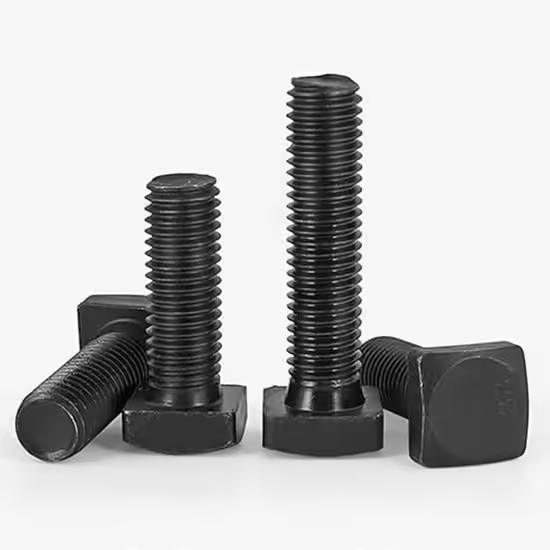
Selecting between 8.8, 10.9, and 12.9 is not just about choosing the strongest option.
1. Load Requirements
- Use Grade 8.8 for moderate loads
- Use Grade 10.9 for heavy loads
- Use Grade 12.9 for extreme loads or space-constrained designs
2. Safety Factor
Higher grades allow for smaller bolt sizes while maintaining strength. However, they require stricter installation control.
3. Environment
- Corrosive environments require protective coatings or stainless alternatives
- High temperatures may reduce strength of high-grade bolts
4. Fatigue and Vibration
Grade 10.9 is often preferred for dynamic loads because it offers a balance between strength and toughness.
5. Installation Conditions
- Grade 12.9 requires precise torque control
- Over-tightening can lead to sudden failure
Surface Treatment and Coating Considerations
Bolt performance is not only about strength—it is also about durability.
Common treatments include:
- Zinc plating: basic corrosion protection
- Hot-dip galvanizing: excellent outdoor resistance
- Black oxide: minimal protection, mainly aesthetic
- Advanced coatings: for chemical or marine environments
Important note:
High-strength bolts (10.9 and 12.9) are more sensitive to hydrogen embrittlement during plating processes. Proper treatment is essential.
Common Mistakes to Avoid
Choosing Higher Grade Without Need
Higher strength does not always mean better. It can increase cost and risk of brittle failure.
Ignoring Installation Torque
Incorrect torque is one of the main causes of fastener failure, especially for Grade 10.9 and 12.9.
Overlooking Environmental Factors
Using carbon steel bolts without coating in corrosive environments leads to rapid degradation.
Mixing Bolt Grades in One Assembly
Different grades behave differently under load, which can cause uneven stress distribution.
Expert Insight: Manufacturer Perspective

From manufacturing and field experience, the most effective bolt selection strategy is:
- Match grade to actual load, not assumed load
- Balance strength with ductility
- Consider installation conditions as part of design
In many real-world cases, Grade 10.9 provides the best balance of performance, reliability, and cost for heavy-duty industrial applications.
Grade 12.9 should be reserved for specialized applications where maximum strength is essential and installation can be strictly controlled.
Conclusion
Understanding the differences between bolt grades 8.8, 10.9, and 12.9 is essential for ensuring structural integrity, safety, and long-term performance in industrial applications.
The right choice depends not only on strength but also on environment, load conditions, and installation practices. By selecting the appropriate grade and applying it correctly, you can significantly reduce failure risks and improve system reliability.
FAQ
What is the difference between 8.8 and 10.9 bolts?
Grade 10.9 bolts have higher tensile and yield strength, making them suitable for heavier loads and more demanding applications.
Are 12.9 bolts always better?
No. While stronger, they are less ductile and more prone to brittle failure if not properly installed.
Can I replace 8.8 bolts with 10.9?
In many cases yes, but you must ensure compatibility with the design and tightening requirements.
Which bolt grade is best for heavy machinery?
Grade 10.9 is typically the best choice due to its balance of strength and durability.
Do higher-grade bolts require special installation?
Yes. Higher-grade bolts require precise torque control and proper tools to ensure correct preload.
Need Help Choosing the Right Bolt Grade?
If you’re unsure which bolt grade is suitable for your application, our engineering team can help you evaluate load requirements, material options, and environmental conditions. Contact us today for expert support and customized fastening solutions designed for your project.
 English
  Spanish
  Arabic